When British warships bombarded the Castillo de San Marcos in 1702, something unexpected happened. Instead of shattering like traditional stone, the fort’s coquina walls absorbed the cannonballs, quietly swallowing them whole. The British found themselves firing into what one frustrated commander called “a bank of sand”, and yet another said “our shots sank into the fortification like raisins into pudding.” Today, you can still see these embedded cannonballs, silent testimonies to the remarkable engineering that made this fort so resilient.
The Wooden Age: Nine Forts Before the Stone
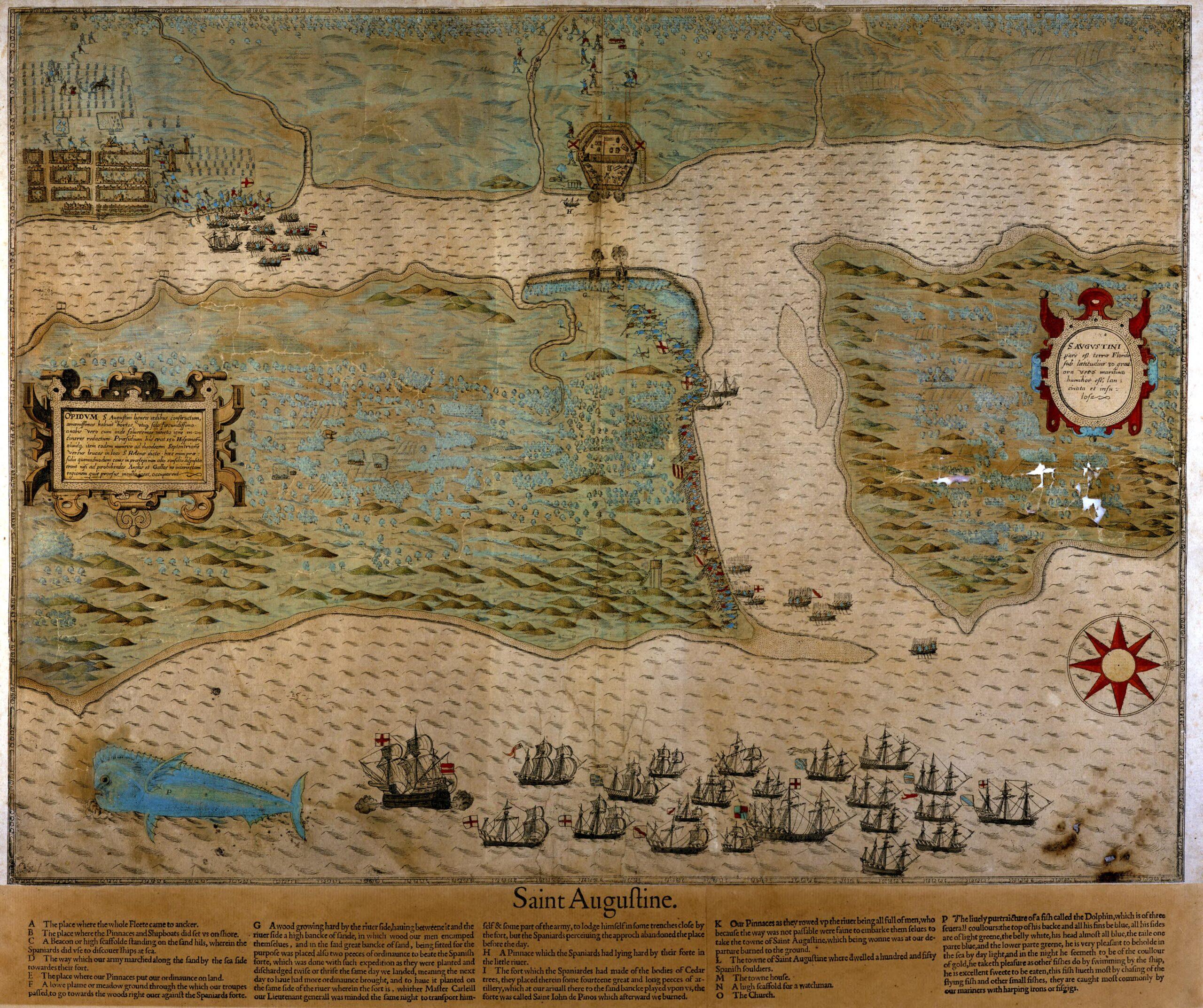
St. Augustine’s first fort wasn’t Spanish at all – it was a Timucuan council house in the village of Seloy. When Pedro Menéndez arrived in 1565, Chief Seloy allowed the Spanish to convert this structure into their first fortification. The partnership didn’t last. Within a year, relations soured, and the Timucuans burned the converted council house, forcing the Spanish to rebuild elsewhere.
The second fort, constructed on Anastasia Island in 1566, proved equally problematic. Built from wood and sand, it offered better protection from native attacks but couldn’t protect supply ships entering the harbor. The Spanish quickly learned that Florida’s environment was as formidable an enemy as any human force. Wood rotted in the humid air, termites invaded the structures, and storms regularly damaged the walls.
Between 1570 and 1672, the Spanish would build seven more wooden forts, each attempting to solve the problems that plagued its predecessors. Archaeological evidence from these successive forts shows increasingly sophisticated construction techniques. The sixth fort introduced earthwork walls that better absorbed artillery fire. The eighth incorporated a primitive version of the star-shaped design that would later define the Castillo.
Building with Stone from the Sea
After English pirate Robert Searle’s devastating raid in 1668, the Spanish Crown finally authorized funds for a stone fort. But traditional European building materials like granite or limestone weren’t available in Florida. The solution lay just across the bay on Anastasia Island, where outcrops of coquina – a sedimentary rock formed from compressed seashells – had been noted by Spanish observers.
Initially, Spanish engineers were skeptical of coquina. The stone was so soft you could break pieces off with your hands when first quarried. Yet they discovered something remarkable: once exposed to air, coquina hardened considerably. More importantly, its unique composition of tiny shell fragments and air pockets created a material that would compress rather than shatter under impact – a property that would prove invaluable against cannon fire.
Engineering the Impregnable

Construction began in 1672 under the direction of engineer Ignacio Daza. The project would take 23 years and require a massive workforce of Native American laborers, Spanish convicts, and both enslaved and free Africans. Quarrying the coquina alone was an enormous undertaking. Workers had to cut blocks from the Anastasia Island quarries, transport them across the bay on barges, and then haul them to the construction site.
The fort’s design followed the most advanced military engineering principles of the day. Its star shape, with four diamond-shaped bastions, eliminated blind spots and created interlocking fields of fire. The walls, built 14 feet thick at the base, slope inward to deflect cannonballs and distribute the enormous weight. A moat, originally deeper than what visitors see today, surrounded the fort on all four sides.
Secret of the Shells
Modern engineering analysis has revealed why the Castillo proved so resilient. The coquina stone contains roughly 40% void space between its shell fragments. When struck by a cannonball, these tiny pockets compress and absorb the impact energy rather than transferring it through the wall. Think of firing a bullet into sand versus concrete – the Castillo’s walls behaved more like the former than the latter.
The First Test of Castillo: The Siege of 1702

Queen Anne’s War brought the Castillo its first major test. In November 1702, English forces under James Moore laid siege to St. Augustine. With 1,200 troops and several ships carrying heavy cannon, Moore expected the fort to fall quickly. Instead, he watched in frustration as his cannonballs disappeared into the coquina walls, leaving only shallow impressions rather than the devastating breaches he expected.
For 58 days, the garrison of 1,500 soldiers and civilians endured constant bombardment. Governor José de Zúñiga y Cerda had ordered all of St. Augustine’s residents into the fort prior to Moore’s arrival. The Spanish ordered canons to fire on buildings within distance of the fort in St. Augustine, as an attempt to deny the British of any potential spoils the town may have held. Archaeological evidence from this period shows how the fort’s occupants adapted to siege conditions: food stores were carefully rationed, rainwater was collected from the terreplein (gun deck), and even the moat, being intentionally built as a dry-moat held livestock temporarily to supplement the other dwindling provisions.
The Greatest Challenge: Oglethorpe’s Siege
In 1740, English forces under James Oglethorpe mounted the most serious challenge to the Castillo’s defenses. Oglethorpe brought something new to the siege – mortars capable of firing explosive shells in high arcs over the walls. Yet once again, the fort’s design proved equal to the challenge. The vaulted casemate ceilings, built to Spanish specifications that seemed excessive to earlier critics, effectively deflected these plunging shots.
British Innovations and Spanish Return

When the British took possession in 1763 through the Treaty of Paris, they immediately began modernizing the fort, now renamed Castle St. Mark. British engineers added a new hot shot furnace – still visible today – designed to heat cannonballs until glowing red. These superheated projectiles could set enemy ships ablaze. The British also raised and reinforced the seawall, modifications that would help the fort survive another century of storms and siege.
The Spanish return in 1784 found the fort stronger than ever. Spanish engineers maintained the British improvements while adding their own refinements. The second Spanish period saw the completion of the covered way and glacis (the long earthen slope that still surrounds the fort), providing additional protection against artillery fire and giving the fort its current distinctive profile.
American Acquisition and Evolution
When Florida became part of the United States in 1821, the fort entered a new chapter. Renamed Fort Marion, it served various military functions, including as a prison during the Seminole Wars. The fort’s most famous prisoner, the Seminole leader Osceola, was held here in 1837. His imprisonment demonstrated the fort’s transition from defending against external threats to serving new military purposes.
Scientific Understanding of an Engineering Marvel
Modern analysis has finally explained why the Castillo proved so effective. Studies of the coquina walls using ground-penetrating radar and core samples have revealed the fort’s sophisticated engineering. The walls were built in three distinct layers: an exterior face of precisely cut blocks, a core of rough coquina pieces, and an interior face of finished stone. This layered construction, combined with coquina’s natural properties, created a structure that could flex without breaking.
The star-shaped design, revolutionary for its time, has proven equally impressive under modern analysis. Computer modeling has shown how the angled bastions create zones of interlocking fire that eliminate blind spots while minimizing the fort’s vulnerable surface area. Even the moat’s dimensions were precisely calculated – wide enough to prevent enemies from bridging it easily, but narrow enough to be covered by fire from multiple positions.
Living History in Stone

Today, the Castillo stands as more than just America’s oldest stone fort. It represents a triumph of engineering adapted to local conditions. Every aspect of its construction, from the unique properties of coquina to the sophisticated ventilation systems that still function, demonstrates how colonial builders solved complex problems with available resources.
Preserving an American Treasure
Efforts to preserve the Castillo began long before modern conservation methods. When the U.S. Army ended its military use of the fort in 1899, local citizens recognized the importance of protecting this unique structure. The fort’s transfer to the National Park Service in 1933 marked the beginning of systematic preservation efforts that continue today.
Modern preservation work reveals new insights into the fort’s construction. Conservators working on the walls have discovered original tool marks that show precisely how Spanish stonemasons shaped the coquina blocks. Ground-penetrating radar studies have identified previously unknown features, including original foundation systems that help explain how the massive structure has survived centuries of hurricanes and flooding.
The Castillo Today
The fort’s resilience continues to impress modern engineers. During Hurricane Matthew in 2016, the Castillo demonstrated why Spanish engineering remains relevant. While storm surge flooded much of downtown St. Augustine, the fort’s original drainage systems – designed over 300 years ago – helped channel water away from the foundations. The coquina walls, which have endured more than three centuries of storms, stood firm against some of the strongest winds to hit the city in recent history.
Perhaps most remarkably, the Castillo still performs many of its original functions. The sentry boxes (garitas) that provided shelter for colonial guards now protect modern park rangers from Florida’s sun and storms. The complex ventilation system, designed before the age of air conditioning, still creates cooling air currents through the casemates. Even the gun deck’s precise slope, calculated to channel rainwater into the cisterns, continues to function exactly as its builders intended.
A Legacy in Stone
Standing atop the Castillo’s gun deck today, visitors can touch the same coquina walls that absorbed British cannonballs, sheltered Spanish families, and witnessed the transition of Florida from colony to state. This isn’t just preserved history – it’s living engineering that continues to protect and serve its community. The fort remains what it has always been: a testament to human ingenuity and the remarkable story of how builders from another age created something that centuries of storms, sieges, and time itself couldn’t break
Discovering More of St. Augustine’s Military Heritage
The Castillo de San Marcos stands as just one chapter in St. Augustine’s remarkable military history. From the wooden forts that preceded it to the Second Spanish Period’s additional fortifications, from British defensive innovations to its role in the Civil War, the story of St. Augustine’s defenses spans nearly half a millennium.
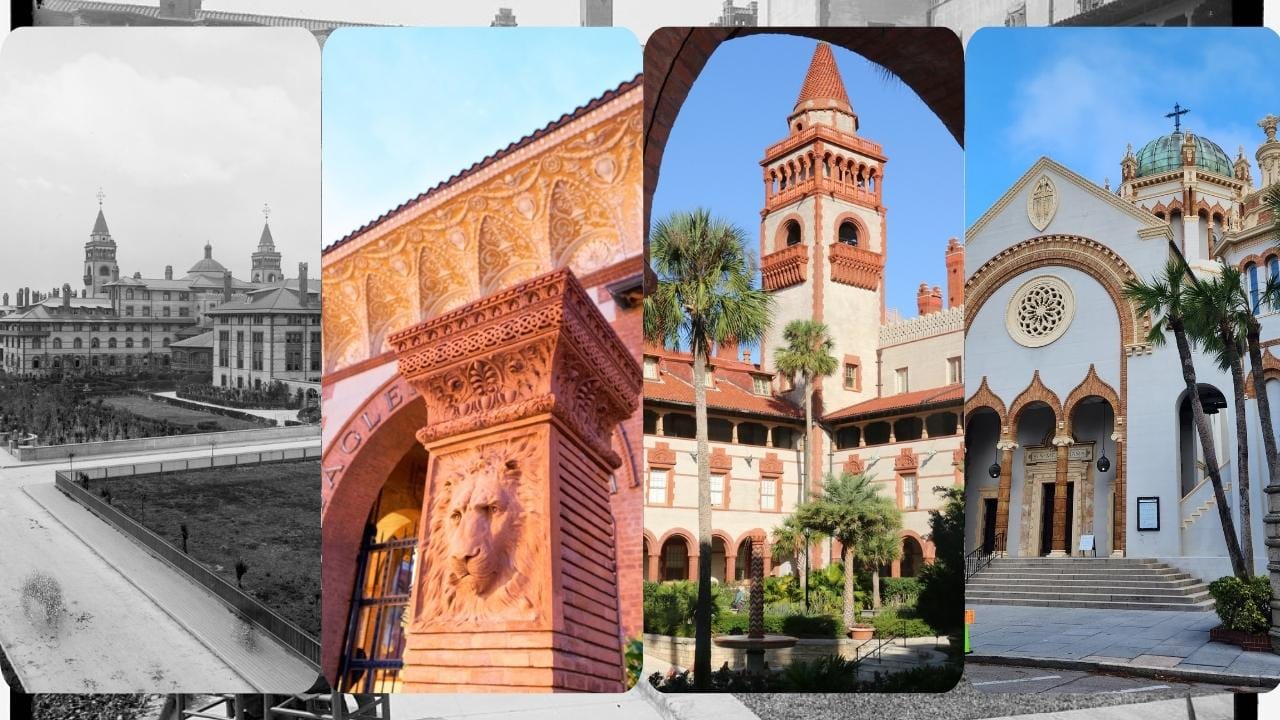
Today, visitors experiencing the Castillo might find themselves wondering about the broader story – how did this massive stone fortress influence the development of colonial St. Augustine? What role did it play in the city’s famous Spanish Colonial period? How did Henry Flagler’s grand hotels of the Gilded Age manage to complement rather than overshadow this ancient sentinel?
Discover these stories and more in our detailed articles about St. Augustine’s Spanish Colonial Period, the Flagler Revolution, and the city’s unique architectural heritage. For an even deeper understanding of how this remarkable fort fits into the broader tapestry of America’s oldest city, download our comprehensive guide, “St. Augustine: A Living History.”
Whether you’re planning your first visit to the Ancient City or seeking to deepen your knowledge of this unique place, understanding the Castillo helps unlock the story of how a remote Spanish outpost became one of America’s most fascinating historical treasures.